
First Impressions: Reception Area Floor Care and Hartford VT Office Cleaning Services
In the professional landscape of Hartford, Vermont, the physical condition of a business facility speaks before any staff member does. During the long New England winter and the notoriously slushy spring mud season, maintaining a pristine environment becomes a significant operational challenge. Clients arriving for meetings often step out of harsh weather and directly into your reception area.
If they are greeted by stained waiting room carpets, dull tiles, or heavy salt tracking, their immediate perception of your business is compromised. Customer trust is heavily influenced by these environmental cues. A neglected entryway suggests a lack of attention to detail, which can translate into a perceived lack of professional competence.
Conversely, a carefully maintained facility communicates order, reliability, and respect for the client. Understanding the mechanics of floor preservation and utilizing targeted Hartford VT Office Cleaning Services provides the structural defense necessary to protect your commercial assets. This proactive approach secures client confidence and protects your revenue streams throughout the harshest seasons of the year.
The Impact of Environmental Soil on Client Perception
When individuals enter a commercial building, their eyes naturally track downward to navigate the transition from the outdoors. This makes the entryway floor the most highly scrutinized surface in your facility. In a region where weather introduces continuous environmental debris, the condition of this specific zone dictates the baseline of professional trust.
During the colder months, visitors track in a mixture of wet snow, abrasive sand, and chemical ice melts. As this material dries on commercial flooring, it leaves a highly visible, chalky white haze. On carpets, this combination creates dark traffic lanes and stiff, matted fibers. If a waiting room looks and feels gritty, clients may unconsciously question the overall operational standards of the firm.
Protecting the aesthetic value of this space requires moving beyond basic janitorial routines. Relying on a standard broom or a wet mop often smears the fine silt and dissolved salts rather than capturing them. Establishing a rigorous floor care protocol prevents this visual degradation, ensuring that the first physical interaction a client has with your business is overwhelmingly positive.
The Mechanics of Winter Floor Damage
The primary threat to commercial flooring in the Upper Valley is not simple dirt, but rather the chemical composition of winter road treatments. Calcium chloride and magnesium chloride are widely used to melt ice on sidewalks and parking lots. These compounds are highly alkaline and naturally hygroscopic, meaning they actively draw moisture out of the surrounding air.
When these salts are tracked onto a commercial carpet, they create a persistent, damp, high-pH environment. This sticky alkaline residue acts as a powerful magnet for daily dust and soil, causing the entryway to look heavily soiled within hours. On hard surfaces like Vinyl Composition Tile (VCT), the abrasive sand mixed with the salt acts like microscopic sandpaper. Every footstep grinds this grit into the protective wax coating, rapidly destroying the finish and leaving the floor permanently dull and vulnerable.
Applying standard household soaps to these areas frequently exacerbates the issue. Typical detergents are also highly alkaline, which simply adds to the high-pH problem without breaking the chemical bond of the salt. Safely neutralizing this specific environmental threat requires targeted extraction methods and pH-balanced solutions to fully wash the abrasive materials out of the building fully.
Defending the Entryway with Walk-Off Zones
The most effective strategy for managing winter and spring soil is preventing it from migrating past the front door. Implementing a multi-stage walk-off mat system is a mandatory defense mechanism for any high-traffic commercial facility. A properly designed matting system captures the vast majority of moisture and grit before it reaches the main reception carpet or hard flooring.
A functional system requires at least ten to fifteen feet of continuous matting. The exterior should feature an aggressive scraper mat to dislodge heavy snow and mud. Immediately inside the door, an absorbent interior mat captures the finer silt and chemical moisture. To remain effective, these mats must be actively maintained and routinely extracted.
If walk-off mats become saturated with salt and sand, they cease to function as a barrier and instead become a secondary source of contamination. Regular, powerful vacuuming and scheduled hot water extraction are required to empty their holding capacity. Reviewing educational resources on surviving mud season in the Upper Valley can help facility managers establish the correct protocols to manage these critical transition zones.
The Financial Case for Hartford VT Office Cleaning Services and Floor Maintenance
Viewing floor care solely as an aesthetic concern ignores the significant financial implications of facility maintenance. Commercial-grade carpeting and hard flooring represent substantial capital investments. Allowing abrasive grit and alkaline salts to remain on these surfaces dramatically accelerates their physical deterioration, leading to premature and costly replacements.
When sand settles deep into the primary backing of a reception area carpet, it physically cuts the nylon fibers under the weight of daily foot traffic. Over a single harsh winter, this internal abrasion can cause the carpet to thin out and lose its structural tension. By the time the damage is clearly visible to the naked eye, the carpet is often beyond salvage and must be replaced entirely.
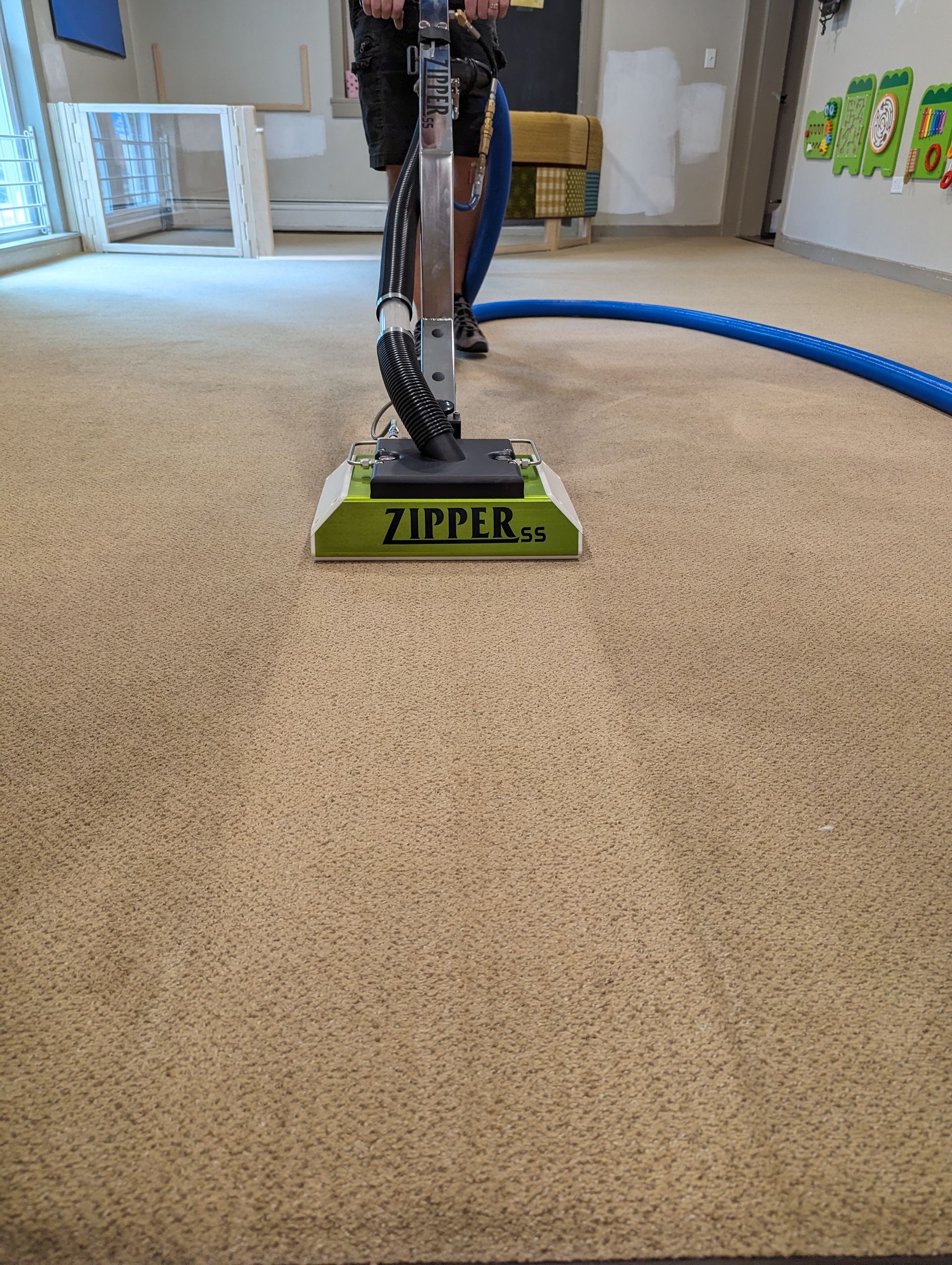
Routine extraction removes this hidden hazard. Establishing a relationship with professional commercial cleaning services ensures that heavy soils are physically flushed from the environment before they cause structural harm. By prioritizing preventative maintenance, business owners extend the functional lifespan of their interior assets, turning cleaning from a basic operational expense into a strategic financial protection measure.

Frequently Asked Questions
Why do winter salt stains keep reappearing on my office carpets?
Winter salt stains, often caused by calcium chloride, are highly water-soluble and easily wick up the carpet fibers. When you attempt to clean a salt stain with a basic wet cloth or a standard carpet shampooer, you often push the salt deeper into the carpet backing.
As the carpet dries, the moisture travels back up the fiber, carrying the dissolved salt with it. This causes the white, chalky stain to reappear on the surface a day or two later. Permanently removing the stain requires a specialized acidic rinse to neutralize the alkalinity and powerful hot water extraction to physically pull the dissolved minerals out of the carpet pad.
How often should a commercial reception area be vacuumed during mud season?
During the high-traffic weeks of the New England mud season, reception areas and entryways should ideally be vacuumed daily. The fine silt and sand tracked in during this period are highly abrasive and will quickly damage floor finishes if left unattended.
It is critical to use a vacuum equipped with a sealed HEPA (High-Efficiency Particulate Air) filter. Standard vacuums often fail to contain the fine clay dust associated with mud season, simply exhausting the microscopic particles back into the office air. Daily HEPA vacuuming captures the grit and protects both the flooring and the indoor air quality.
Does mopping effectively clean salt off of commercial tile floors?
Standard wet mopping is generally ineffective at removing heavy salt accumulation. When a wet mop is pushed across a salty floor, the water dissolves the salt, creating a briny solution. The mop then spreads this solution evenly across the tile and into the porous grout lines.
When the floor dries, the salt remains behind as a dull, hazy film. To properly clean VCT or tile floors in the winter, the floor must be cleaned with a dedicated neutralizer. Additionally, the dirty water must be completely removed using a wet-vacuum or an auto-scrubber, rather than being left to evaporate on the surface.
What is the best type of mat for a business entryway in the winter?
An effective commercial entryway requires a dual-mat system to handle New England weather. The exterior mat should be a heavy-duty rubber scraper design. This physical barrier dislodges packed snow, ice chunks, and heavy mud from the treads of boots before the person steps inside.
Immediately inside the door, you should place a highly absorbent, commercial-grade fabric mat. This interior mat captures the remaining moisture, dissolved salt, and fine sand. These mats must be long enough to require a visitor to take at least three to four steps on them to effectively dry their footwear.
Can a dull commercial tile floor be restored, or does it need to be replaced?
In most cases, a dull Vinyl Composition Tile (VCT) floor can be completely restored without the need for replacement. The dullness is typically the result of microscopic scratches in the top layer of the acrylic wax finish, caused by foot traffic and abrasive sand.
Professional technicians can strip away the old, damaged layers of wax, safely removing the embedded dirt and yellowing. Once the floor is stripped back to its clean foundation, several fresh coats of high-quality commercial finish are applied. This stripping and waxing process restores the original shine and provides a durable new layer of protection for the tile beneath.
Conclusion
Maintaining a professional commercial environment in the Upper Valley requires navigating distinct environmental stressors. The combination of winter road salt, spring mud, and heavy foot traffic continuously threatens the condition of reception areas and entryways. Relying on basic sweeping or generic soaps leaves abrasive grit behind, gradually destroying expensive flooring assets and communicating a subtle lack of care to arriving clients.
By understanding the chemistry of seasonal soil and prioritizing targeted extraction methods, business owners can protect their investments. Implementing rigorous floor care protocols and securing regular Hartford VT Office Cleaning Services ensures that your facility consistently projects an image of competence, reliability, and respect. This attention to detail secures the trust of every client who walks through your door.
For readers looking for additional information or professional support related to this topic, Flanders Cleaning Services provides residential and commercial cleaning services in the Upper Valley region of New Hampshire and Vermont. Learn more at https://www.flanderscleaning.com/.